Singapore Visa Guide: Types, Process and Requirements

A visa for Singapore is a pre-entry permission that some nationalities must obtain before travelling, and it is separate from the passes that allow you to live and work here. Most visitors only need to confirm whether their passport requires one, while those planning a long stay need the right work or family pass instead. This guide explains how a visa for Singapore works, who needs one, how to apply, and where it sits in the wider path from a Work Permit to Permanent Residence (PR).
Do I need a visa for Singapore?
Whether you need a visa depends on the travel document you hold, not on your reason for visiting. The Immigration & Checkpoints Authority (ICA) states that an entry visa is pre-entry permission rather than an immigration pass, and that it does not guarantee entry. ICA officers decide admission at the checkpoint.
Holders of travel documents issued by countries such as Afghanistan, Bangladesh, India, Nigeria, Pakistan and Russia must have a valid Singapore entry visa before arrival, though the full list is published by ICA. ICA publishes the full list, and the list can change, so check your own document and circumstances on the ICA website before booking.
Nationals of many other countries do not need a visa for short visits. They are still subject to ICA's checks at the border. Two practical points apply to everyone:
- Your passport should be valid for at least six months from the date you enter, as ICA requires for social or business visits.
- ICA's visitor guidance notes that a visa does not guarantee entry, because ICA officers decide admission at the checkpoint.
If you are already working in Singapore on a Work Permit, S Pass or Employment Pass (EP), this section mainly matters for your family members and visiting relatives, who may need a visit visa depending on their nationality.
What types of visa and pass are there?
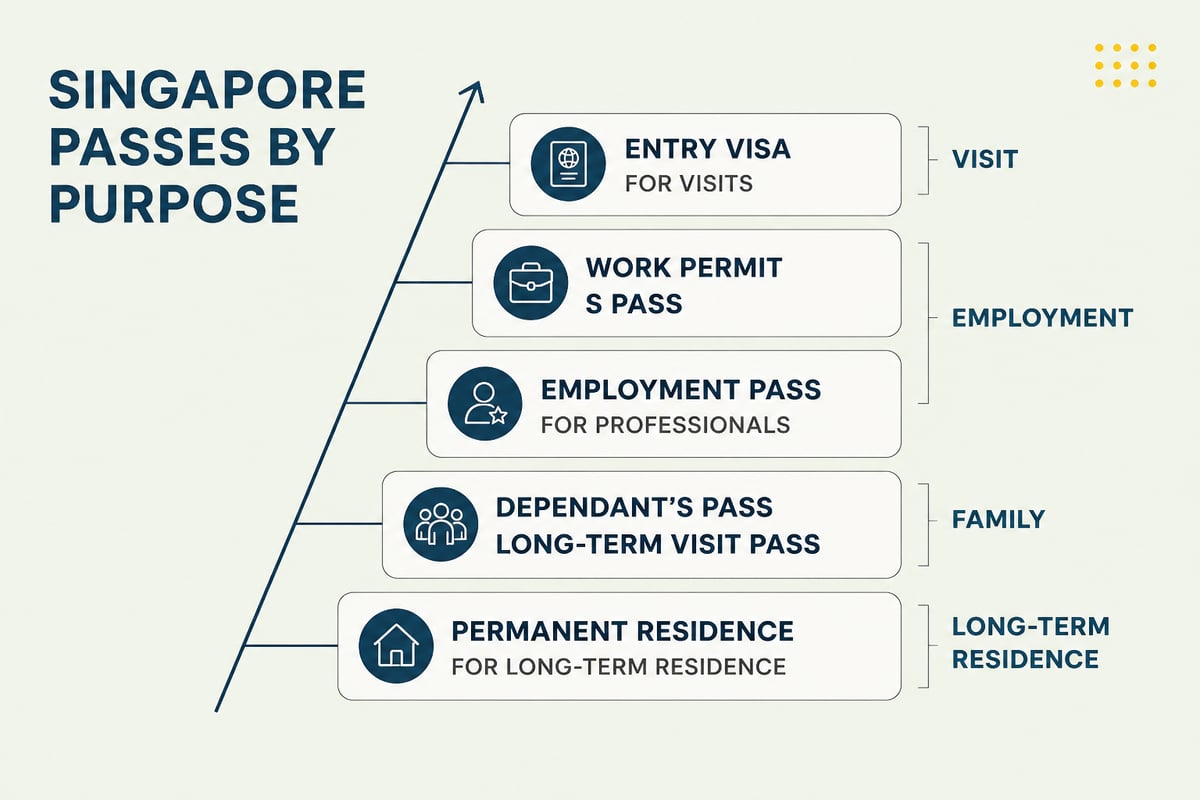
Singapore separates short visits from long-term stays: an entry visa covers a social or business visit, while work and family passes are issued by the Ministry of Manpower (MOM) for residence. Understanding this split avoids the most common planning error, which is assuming that a visa allows you to work.
| Category | Typical holder | Main purpose |
|---|---|---|
| Entry visa and Visit Pass | Visitors from visa-required countries | Social or business visit, no employment |
| Work Permit | Skilled and semi-skilled workers in approved sectors | Employment with a sponsoring employer |
| S Pass | Mid-level skilled staff | Employment, subject to MOM criteria |
| Employment Pass (EP) | Professionals, managers and executives | Employment at a higher skill and salary tier |
| Dependant's Pass (DP) | Spouse and children of eligible pass holders | Residing with the main pass holder |
| Long-Term Visit Pass (LTVP) | Eligible family members, such as spouses of citizens or PRs | Extended stay for family reasons |
| Permanent Residence (PR) | Applicants assessed by ICA as suitable | Long-term residence with fewer pass restrictions |
For a closer look at the employment side, the overview of the Singapore work permit visa explains how the sponsoring employer, the pass tier and the applicant's profile fit together. Readers who want to understand how passes differ in practice can also read about work passes in Singapore.
How do I apply for a visa for Singapore?
You apply for a visa for Singapore through ICA's channels, supported by a completed form, a photograph and your passport details, and you receive the outcome electronically. The exact submission route depends on your nationality and circumstances, so confirm it on the ICA site before you begin.
- Confirm that your travel document requires a visa. Use ICA's published guidelines rather than third-party summaries.
- Prepare your documents. For social or business visits, ICA's published requirements list a completed Form 14A, a recent passport-sized colour photograph and a copy of your passport biodata page. Additional documents may be requested case by case.
- Submit through the permitted channel. Details of the electronic route are covered in this guide to the Singapore e-visa application.
- Pay the processing fee. ICA's stated entry-visa processing fee is S$30, and it is non-refundable even if the application is unsuccessful.
- Receive the outcome electronically and keep a copy for travel.
If you need help understanding the paperwork, this explainer on the Singapore visa application form breaks down what each section asks for.
How long does a Singapore visa take and when should I apply?
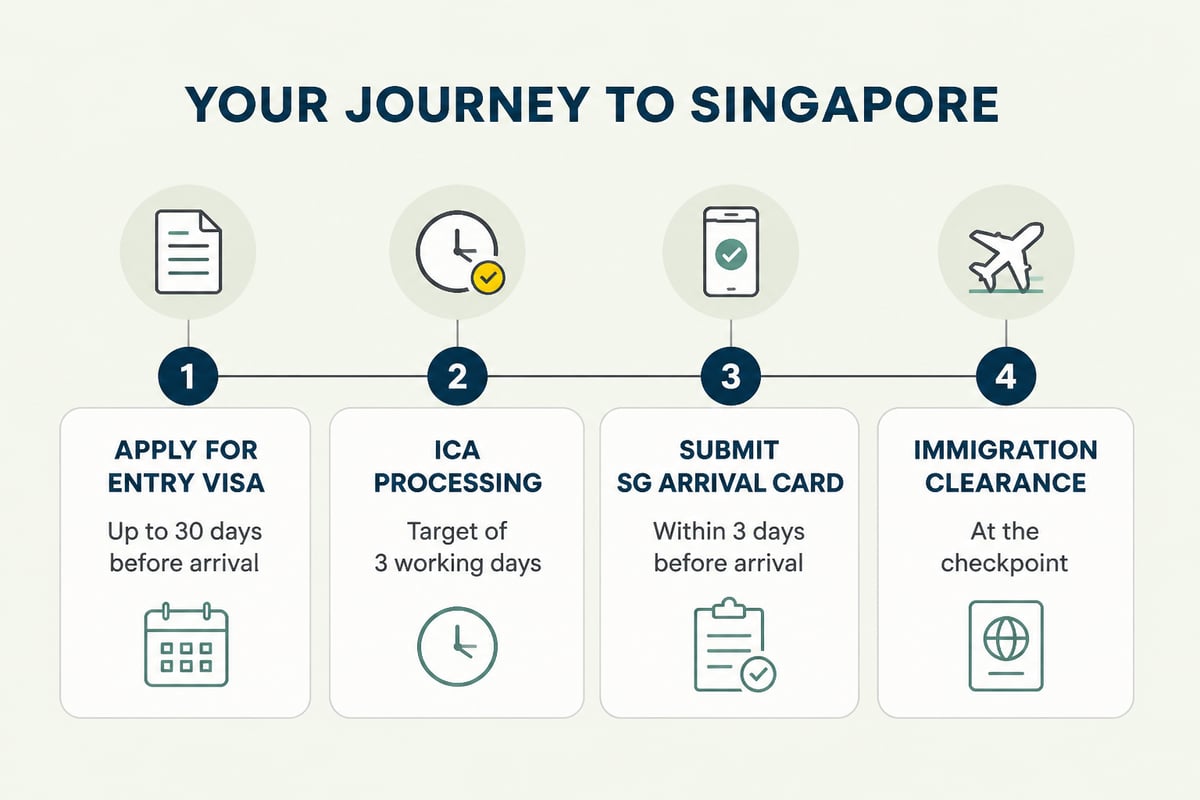
ICA's service commitment is to process visa applications within three working days after receiving all required documents, although some applications take longer. A short processing target is not a guarantee, so build in a margin rather than planning to the day.
ICA advises applying for an entry visa within 30 days before arrival for the social or business visit process it describes. Applying too early can leave you with an application that does not align with your travel dates, while applying too late risks delays at the point you most need certainty.
You can follow an application after submission. The guide to ICA Singapore visa status explains how status checks generally work.
Three practical habits reduce the risk of delay:
- Check that the name and passport number match across every document.
- Submit a clear, correctly sized photograph.
- Reply promptly if ICA asks for additional documents.
Is the SG Arrival Card the same as a visa?
No. The SG Arrival Card with electronic health declaration is a free entry formality and is not a visa. ICA states that most travellers must submit it within three days before arrival, including the day of arrival. Travellers who transit without clearing immigration are exempt.
This distinction is a frequent source of confusion, particularly for the Digital Arrival Card question many travellers ask. Yes, it is completed online, and you should use only the official SG Arrival Card page on ICA's website. Submitting it does not replace a visa where one is required, and holding a visa does not exempt you from the card.
Does the Visa Free Transit Facility apply to me?
The Visa Free Transit Facility may be available to eligible nationals of the Commonwealth of Independent States, Georgia, India, Turkmenistan and Ukraine, subject to ICA's conditions. It is relevant mainly to travellers who pass through Singapore on the way to another destination rather than entering the country for a stay.
Because the conditions can change and depend on onward travel arrangements, treat this as something to verify on ICA's site before you fly. Do not assume that transit permission carries over to a visit, and never assume it allows any form of work.
Why a visit visa is not a route to working in Singapore
A visit visa does not permit employment, and employment passes are applied for through MOM by a sponsoring employer, not from a visitor's status. Anyone who intends to work should plan the pass first and the travel second.
For Work Permit and S Pass holders considering an upgrade, the question is usually how to strengthen the profile that MOM assesses. Factors include salary, qualifications, work history and the role itself. Some Work Permit holders pursue part-time diplomas or degrees to build their academic profile ahead of an S Pass or EP application, though MOM makes the final decision on every pass.
Employers face parallel considerations. MOM and ICA assess each case on its own facts, and nobody outside those agencies can promise an outcome.

What about family members and long-term stays?
Family members of eligible pass holders may apply for a Dependant's Pass (DP), and some relatives of citizens or PRs may qualify for a Long-Term Visit Pass (LTVP). Eligibility for each depends on the main pass holder's category and the relationship involved.
A visit visa is a poor fit for families who intend to relocate, because it does not confer residence rights. Setting up the correct pass early gives children a clearer route into local schooling and gives spouses a clearer basis for their stay.
How does a visa connect to Permanent Residence?
A visa is the first step in a sequence, and PR is assessed holistically by ICA rather than earned through a fixed checklist. ICA considers factors such as work history, salary, education, family ties and integration into Singapore society. No single factor decides the outcome, and no consultancy can guarantee it.
Applicants who hold an EP or S Pass, or who have a Singaporean or PR spouse, often begin thinking about PR once their circumstances are stable. A realistic review looks at how long you have lived here, how consistent your employment record is, and how your household is established. Kenneth & Co Pte Ltd supports applicants through the Singapore PR and Citizenship application, covering case review, document preparation and application strategy, with ICA making the final decision. Every application is assessed case by case before anything is filed.
For readers weighing up the decision, factors to consider before applying for Singapore PR is a useful companion read.
What are common reasons a visa application fails?
Most refusals and delays trace back to incomplete or inconsistent documentation. ICA may also decline an application for reasons it does not always itemise, and the processing fee is not refunded when that happens.
- Passport validity. A passport with fewer than six months remaining from the entry date, which is a common reason for problems at the border.
- Mismatched details. Names, dates or passport numbers that differ between the form and supporting papers.
- Unclear purpose of visit. A stated purpose that does not match the documents supplied.
- Wrong visa type. Applying for a visit when the real intention is to work or reside.
- Missing responses. Failing to answer a request for further documents in time.
Careful preparation before filing helps with the first four. If your plans involve more than a short trip, discussing your situation with an immigration consultant before you apply can prevent the fifth kind of problem from arising later.
FAQ
Do I need a tourist visa to visit Singapore?
It depends on your travel document. Holders of documents from the countries ICA lists, including India, Bangladesh, Pakistan, Nigeria and Russia, need a valid entry visa before arrival, while others may not. Check ICA's current guidelines for your passport before you travel.
How much does a Singapore visit visa cost?
ICA's stated entry-visa processing fee is S$30, and it is non-refundable even if the application is unsuccessful. Fees can be revised, so confirm the current amount on the ICA website at the time you apply.
Can I get a Singapore visa in seven days?
ICA's service commitment is to process visa applications within three working days after receiving all required documents. Some applications take longer, so a seven-day window is plausible but not assured, and it is sensible to apply well ahead of your travel date.
If your plans go beyond a short visit, start by listing your current pass, your employment details and your family situation, then check which ICA or MOM route fits. From there, Kenneth & Co Pte Ltd can review your case, with more than 10 years of experience and over 5,000 applicants helped. If you are preparing a long-term application, the Singapore PR and Citizenship application service covers case review, documents and strategy, and you can Book a Consultation with Kenneth & Co Pte Ltd to talk through your options, bearing in mind that MOM and ICA make the final decisions.


