Singapore Visa Guide for Foreigners in 2026

Whether you need an SG visa depends on your nationality and the purpose of your trip: some passport holders can enter Singapore without one, while others must obtain an entry visa before they travel. A visa only lets you reach the checkpoint, and it does not allow you to work or settle. For Work Permit and S Pass holders, business owners and families planning a long-term future here, the real question is which pass comes next. This guide covers entry rules first, then the pass pathway from Work Permit to PR.
Do you need an SG visa to enter Singapore?
Whether you need an SG visa is determined by your nationality, not by the length of your trip. Many nationalities can enter Singapore visa-free for short stays, while others must apply for an entry visa in advance.
The Immigration & Checkpoints Authority (ICA) provides an entry-requirements tool that gives a personalised overview of the documents you need, based on your traveller details. Use it before booking flights, as the rules apply at the point of travel.
Two points are worth keeping in mind:
- Travellers who need an entry visa must obtain one before travel. According to ICA's visa guidelines, holding a visa does not guarantee entry, as that decision rests with ICA officers at the checkpoint.
- A visa is not a work authorisation. If you intend to be employed or run a business in Singapore, you will need the appropriate pass from the Ministry of Manpower (MOM) or ICA.
For readers already in Singapore on a pass, the entry visa matters mainly when your family members or future employees need to visit. For a plain-language walkthrough of how visas are applied for online, see this overview of the ICA visa application process.
What does an entry visa actually allow?
An entry visa allows you to present yourself at a Singapore checkpoint for short-term entry, and nothing more. The length of your stay is not set by the visa.
ICA states that the period of stay is determined by the electronic Visit Pass issued at the checkpoint, and is not tied to the visa's validity. A visa valid for several months does not entitle you to remain that long. Always check the stay period granted on arrival.
This distinction catches many visitors out. Overstaying the period on the Visit Pass can lead to penalties and can affect future applications, which matters greatly if you hope to hold a long-term pass later. ICA assesses each case holistically, and a clean immigration record is part of your overall profile.
What are the passport and arrival requirements?
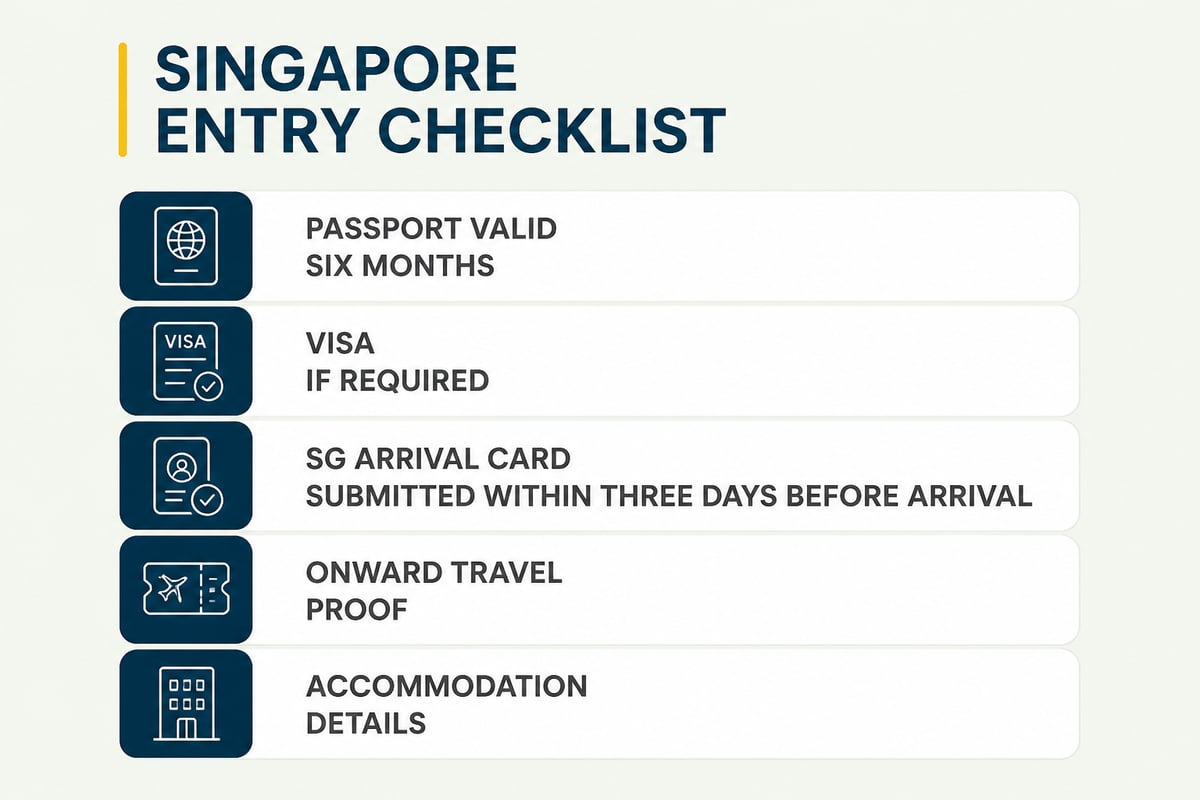
Your passport should be valid for at least six months when you enter Singapore, and you must complete an arrival declaration online beforehand. ICA's entry guidance sets out the six-month validity rule for non-Singapore passport holders.
Before you fly, check these items:
- Passport validity of at least six months from your entry date
- A visa, if your nationality requires one
- Proof of onward or return travel
- A completed SG Arrival Card
- Accommodation details for your stay
Is the SG Arrival Card still required?
Yes. The SG Arrival Card and electronic health declaration must be submitted within three days before arrival, including the arrival date itself, according to ICA's SG Arrival Card page. Submission through ICA is free, so treat any site that charges a fee with caution.
Travellers who are only transiting or transferring, and do not clear Singapore immigration, are exempt. ICA's visitor advisory summarises the arrival procedure, the card and immigration clearance in one place.
How do you apply for an SG visa, and how long does it take?
You apply for an SG visa through ICA's prescribed channels, with a passport valid for at least six months and supporting documents, and processing times vary by nationality and case. Some applications are submitted through a local contact or a registered channel rather than directly by the traveller.
ICA's published guidance for holders of a PRC Travel Document gives a useful sense of the process:
- A non-refundable visa processing fee of S$30
- Processing within three working days in most cases, excluding the submission day, although some applications may take longer
- Applications should be made within 30 days before arrival
- A passport valid for at least six months from the entry date is required
These details come from ICA's PRC Travel Document page and apply to that category specifically. Other nationalities follow different steps, so confirm your own requirements on ICA's website. If you need help with documents, this guide to the Singapore visa application form explains what applicants are typically asked to prepare, and you can track a submission through ICA visa status checks.
Can you live and work in Singapore on a visa alone?
No. A visa or Visit Pass does not allow residence or employment, so anyone who wants to live and work in Singapore needs a pass issued under the relevant scheme. Staying on short-term visits in the hope of converting to a long-term status is not a viable route.
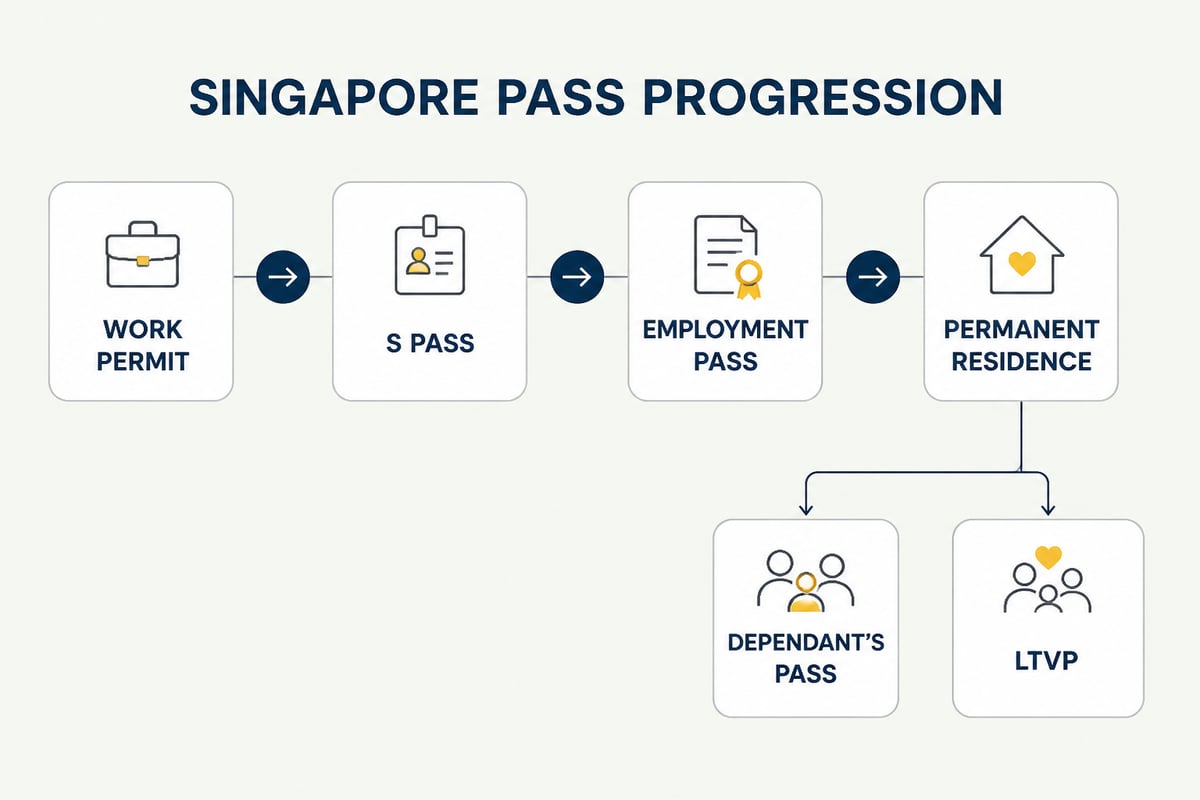
The passes most relevant to long-term residents are:
| Pass | Who it is for | Key point |
|---|---|---|
| Work Permit | Skilled and semi-skilled workers in permitted sectors | Tied to a specific employer and sector |
| S Pass | Mid-skilled technical staff | Subject to salary and qualification criteria set by MOM |
| Employment Pass (EP) | Professionals, managers and executives | Assessed on salary, qualifications and experience |
| Dependant's Pass (DP) | Spouses and children of eligible pass holders | Linked to the sponsor's pass |
| Long-Term Visit Pass (LTVP) | Certain family members and long-stay cases | Granted at ICA's discretion |
Eligibility thresholds and quotas change from time to time, so confirm current criteria with MOM before planning. For a plain comparison, read about the difference between a Work Permit, EP and S Pass, and for an introduction to the pass categories see this Singapore work permit visa overview.
Can a Work Permit or S Pass holder move up to an EP?
Yes, it is possible, but it depends on your profile at the time of application, and MOM makes the final decision. There is no automatic upgrade after a set number of years.
Applicants usually strengthen their case through a combination of factors:
- Salary progression: a higher, well-documented salary relative to your role and sector
- Qualifications: recognised degrees or diplomas, including part-time study completed while working
- Work history: continuity, relevant experience and increasing responsibility
- Employer profile: the stability and standing of the sponsoring company
Many Work Permit holders improve their profile through part-time diplomas and degrees that support a later S Pass or EP application. If you hold a Work Permit and are weighing options, four ways to upgrade to an S Pass sets out the main routes. No approach removes the uncertainty, and a case that looks strong on paper can still be declined.
Can you bring your family to Singapore?
Eligible pass holders can apply for Dependant's Passes for a spouse and children, and in some circumstances a Long-Term Visit Pass for other family members. Eligibility depends on your own pass type and salary, and approval is at the authorities' discretion.
When planning a family move, consider:
- Whether your pass category allows you to sponsor dependants at all
- The timing of your family's applications relative to your own approval
- Schooling, housing and the cost of living for the household
- How a spouse's own pass or employment plans fit with the application
Children's schooling is often a deciding factor for families, and an overview of Singapore's education system helps with that planning.
When should you consider Singapore PR?
Consider PR once you have established stable roots in Singapore, typically as an EP or S Pass holder with a settled work and family life, because PR is the first step towards long-term security rather than a reward for time served. ICA assesses each case holistically, and no single factor decides the outcome.
Factors commonly weighed include:
- Employment record and continuity
- Salary and contribution to the economy
- Education and skills
- Family ties to Singapore, including Singaporean or PR relatives
- Length of residence and integration into the community
There is no published formula, and nobody can promise an approval. What an applicant can do is present an honest, well-documented picture of their life here. If you are weighing the decision, four factors to consider before applying for Singapore PR and the benefits of becoming a Singapore PR are useful starting points.
For applicants who plan to live here long term, Kenneth & Co Pte Ltd offers Singapore PR & Citizenship Application support covering case review, document preparation and application strategy. Applications are assessed case by case, and the final decision rests with ICA.
What should business owners and entrepreneurs know?
Business owners should treat the entry visa, the company set-up and the pass for the owner or key staff as three separate steps, each with its own requirements. Registering a company does not by itself give you the right to live or work in Singapore.
Typical considerations for foreign founders include:
- Whether the owner or key personnel will need an EP, and how the company's profile supports that application
- The company's local hiring plans and its ability to sponsor staff on appropriate passes
- Whether Singapore is the main base or one node in a regional structure, for example alongside Malaysia
Singapore's standing as a regional hub is a common reason for expansion, as explained in why Singapore is considered a global business hub. For cross-border travellers who commute between Johor and Singapore, a door-to-door service such as SG2MY Travel offers private car transfers between the two countries. Remember that crossing the border still requires valid immigration clearance on both sides.
What mistakes should you avoid with an SG visa and pass applications?
The most common mistakes are incomplete documents, inconsistent information across applications and assuming a visa grants more than it does. Each of these can delay a case or weaken your standing in later applications.
Watch for the following:
- Mismatched details: employment dates, salary figures or personal particulars that differ between forms and supporting documents
- Late planning: submitting entry or pass applications close to your travel or expiry date
- Misreading the stay period: relying on visa validity instead of the Visit Pass period granted at the checkpoint
- Unrealistic expectations: treating a pass upgrade or PR as a certainty
Work Permit holders often benefit from reviewing common mistakes made by Work Permit holders before they plan the next step.

FAQ
Do UK citizens need a visa to Singapore?
Entry requirements depend on the passport you hold, so the reliable method is to enter your nationality into ICA's entry-requirements tool before you travel. Even where no visa is needed, you must still meet the passport validity rule and submit the SG Arrival Card.
Can I live in Singapore as a British citizen?
Living in Singapore requires a pass that matches your purpose, such as an EP, S Pass, DP or LTVP, and in time possibly PR. Nationality does not give a right of residence, and MOM and ICA decide each application on its merits.
Start by listing your current pass, salary history, qualifications and family situation on one page, because that snapshot shows which next step is realistic. Kenneth & Co Pte Ltd supports applicants with over 10 years of experience, and for those aiming at residency it offers Singapore PR & Citizenship Application support. If you would like an honest view of where you stand, you can speak with the team through Kenneth & Co Pte Ltd and book a consultation to review your case before filing anything.


