Citizenship Application Tracker: Key Milestones to Watch

A citizenship application tracker for Singapore is a simple record of the milestones between your current pass and a long-term status: where you stand today, which upgrade comes next, and which documents and evidence you need at each stage. Because ICA and MOM decide each case, no tracker can predict outcomes or timings, but a well-kept one helps you see your own progress clearly and avoid avoidable gaps.
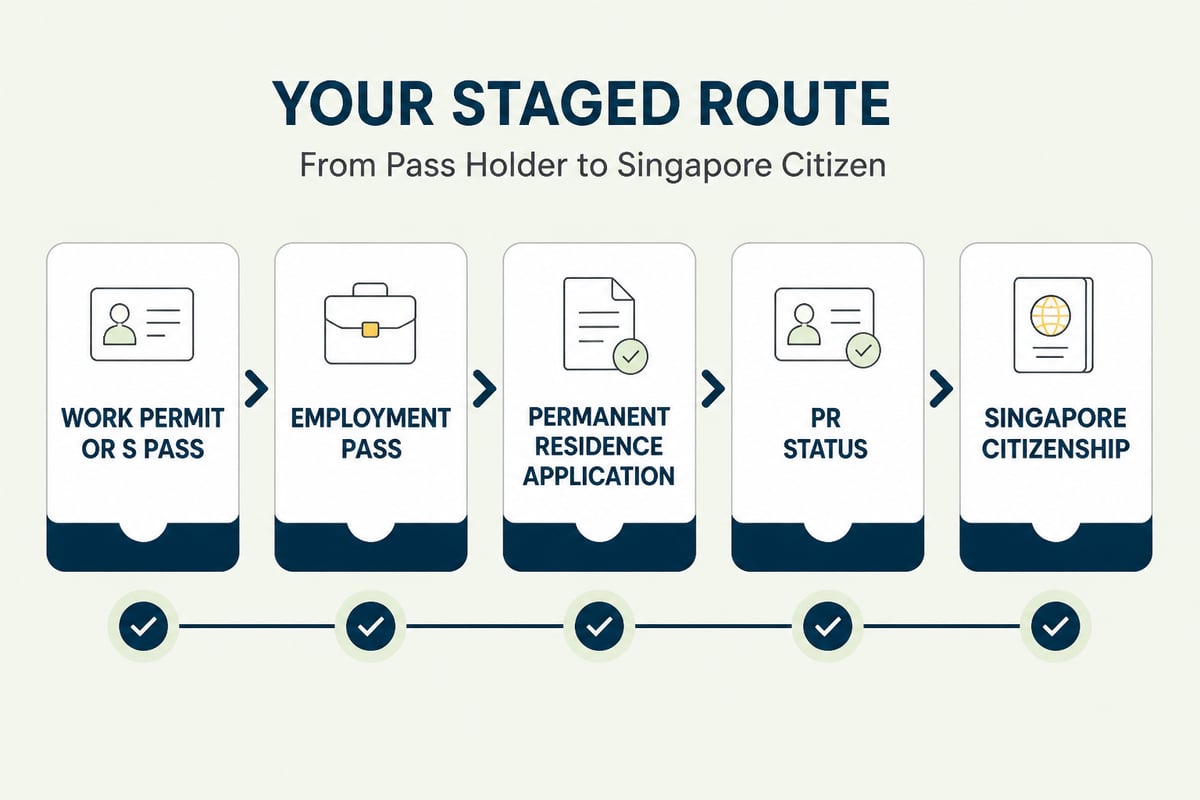
For Work Permit and S Pass holders, the route to citizenship does not begin with a citizenship form. It begins with the pass you hold now, moves through an upgrade to an Employment Pass (EP), and then to Permanent Residence (PR). This article sets out the milestones worth recording, in the order most applicants meet them.
What a citizenship application tracker should record
A good tracker records facts you control and facts you must wait for, and keeps them apart. Facts you control include your employment history, salary changes, qualifications and family details. Facts you wait for include ICA and MOM decisions, which are made case by case.
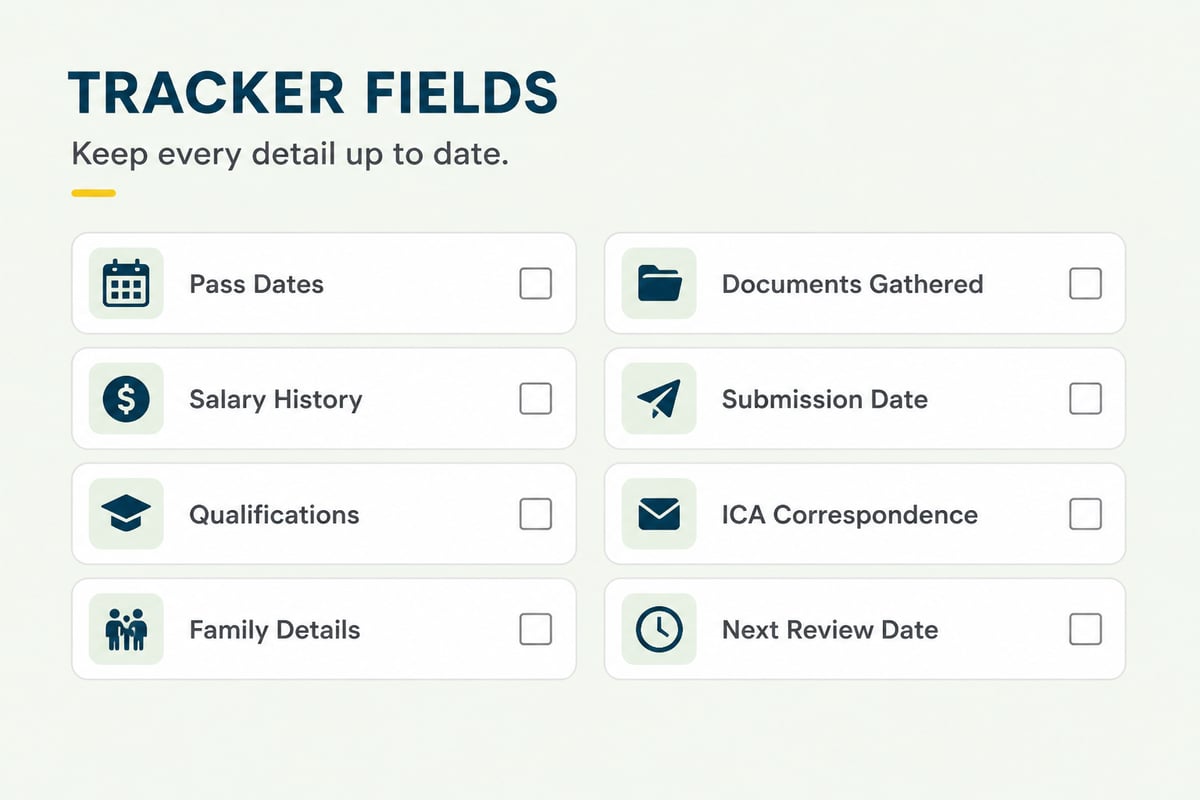
Keep one document or spreadsheet with these fields:
- Current pass type, issue date and expiry date
- Employer name, job title and start date for each role
- Monthly salary history, with dated payslips or letters
- Qualifications, including part-time programmes in progress
- Family members in Singapore and their pass or citizenship status
- Dates of every application submitted and every outcome received
- Notes on community involvement and integration activities
The aim is not to score yourself. ICA assesses each case holistically, so the tracker is a memory aid and an evidence file, not a prediction tool.
1. Confirm your current pass and renewal dates
The first milestone is knowing exactly where your current pass stands, because everything else depends on continuous, valid status. Record the pass type, its expiry date and the date you should begin renewal preparation. A practical rule is to enter a reminder well ahead of expiry, so that a delayed employer letter or a missing document does not push you into a rushed filing. Also note any changes in your employer or job title since the last renewal, as these affect what MOM will look at.
Work Permit and S Pass holders have different renewal conditions from EP holders, and those conditions are set by MOM. Applications to renew work passes are also assessed individually. If you want to understand where renewals commonly go wrong, this article on preventing rejection of a work pass renewal covers the practical points.
For official pass information, MOM publishes the rules on its own site, mom.gov.sg. Treat it as the reference whenever your tracker and a rumour disagree. A useful habit is to save a dated copy of the relevant MOM page whenever you rely on it, so you can show later which rules applied when you made a decision.
2. Track your upgrade from Work Permit or S Pass to EP
The second milestone is the upgrade itself: moving from a Work Permit or S Pass to an Employment Pass where your role and profile support it. Note the date you begin preparing, the date of submission and the outcome. If the upgrade is unsuccessful, record that as well, because the date and the profile you submitted become the baseline for any later attempt.
An upgrade depends on factors such as your job scope, salary, qualifications and employer. Many S Pass holders strengthen their profile through part-time diplomas or degrees, and those belong in your tracker with enrolment and completion dates. A practical example is a technician who enrols in a part-time degree: the enrolment letter, the semester results and the final certificate each deserve a dated entry. The difference between the three pass types is explained in this guide to Work Permit, EP and S Pass differences, which helps you judge which pass your role realistically fits.
Salary is one input among several, not a standalone test. This piece on whether salary matters in a PR application puts it in context. Keep your payslips and any salary revision letters beside the upgrade entry, so the figures and their dates can be read together.
3. Build your evidence file before you apply for PR
The third milestone is a complete, ordered set of documents ready before any PR submission. Gaps found late are the most common reason applications stall, so the tracker should show each document as gathered, checked or missing. Give each item a status and a date, and review the list again a week before you plan to submit, since documents such as employment letters can go out of date quickly.
Typical categories include identity documents, employment letters, payslips, tax records, education certificates and family documents. The exact requirements are set by ICA, and this overview of the documents needed for a PR application lists the usual categories to prepare. Where a document is in another language or was issued overseas, note early whether a certified translation or extra verification is needed, as this can add time.
Two practical habits help:
- Date every document and note its source
- Keep scans in one folder, named consistently
The cover letter also deserves its own line in the tracker. These tips on a PR cover letter show how to present your story clearly and honestly.
4. Submit and log the PR application
The fourth milestone is the submission, and the tracker should capture the date, the reference details and everything you sent. Save a copy of every page and attachment exactly as submitted, so that you can answer any later query against the same record.
Record what you submitted for each family member, as PR applications often cover a spouse and children. Keep a note of any correspondence from ICA, including requests for further information, with the date you replied. If you are asked to supply a document, log both the request date and the day you responded, which gives you a clear timeline if questions arise.
Do not assume a fixed waiting period. Processing varies, and this explanation of why a PR application can take a long time outlines the factors involved without promising a timeline. For official status information, ICA's own site, ica.gov.sg, remains the authority. Avoid changing jobs or details mid-process without recording the change and considering whether ICA should be told.
5. Plan for a rejection or a request for more information
The fifth milestone is not a success at all, and it belongs in the tracker anyway: what you will do if ICA declines the application or asks for more. A short contingency note saves time and stress. Write it while the application is pending, when you can think calmly, and include who you would speak to and which documents you could update quickly.
Rejections are not always final. Applicants often reapply after strengthening their profile, for example through a salary progression, a further qualification or a longer record of stable employment. This article on reasons a PR application is repeatedly rejected lists the patterns that tend to recur. A request for more information is a different situation: it usually means a gap or an unclear point, and a prompt, accurate reply with supporting documents is the sensible response.
ICA does not always give detailed reasons, so avoid guessing. Log the outcome, review your evidence file honestly, and note what you could realistically improve before a later attempt. Set a review date, perhaps a few months out, so the improvement plan has a deadline rather than staying a vague intention.
6. Singapore PR & Citizenship Application support from Kenneth & Co
Kenneth & Co's Singapore PR & Citizenship Application service is a professional support option for applicants who plan to live in Singapore long-term and want help with case review, document preparation and application strategy. It sits alongside doing the tracking yourself rather than replacing it. Your tracker becomes a useful starting point for the first conversation, since dated records let an adviser see your profile quickly and spot gaps without long back-and-forth.
- What it covers: case review, document preparation and application strategy
- How it works: every application is assessed case by case before any filing, and documents are prepared against an ICA due diligence checklist
- Team: a bilingual English and Chinese advisory team, with over 10 years of experience and over 5,000 applicants helped
- Reputation: a 4.8 rating on Google, based on over 500 reviews
- Pricing: not listed here; the contact page is the place to ask
- Suits: applicants with a complex profile, such as a recent pass change, a career gap or family members on different passes
- Verdict: a sensible option if you want a second pair of eyes on your evidence, bearing in mind that ICA makes the final decision
For example, an applicant whose spouse holds a different pass type, or who changed employers shortly before applying, may benefit from having the timeline of those changes explained clearly and consistently across the documents. Support of this kind helps with preparation and presentation; it cannot guarantee a result.
7. Prepare for the citizenship stage
The final milestone is citizenship, which comes after PR and is a separate application with its own considerations. Your tracker should carry forward the same fields, with added emphasis on how long you have lived here and how settled your family life is. Add dated entries for your PR approval, your residence address history and any long periods spent abroad, since these help you describe your ties accurately.
ICA assesses these applications holistically, looking at your ties to Singapore, your contribution and your integration. The practical side of belonging matters too, and this piece on integrating into Singapore's society offers realistic ideas. Record volunteering, community activities and children's schooling as they happen, rather than trying to reconstruct them years later.
For official wording and eligibility, check ICA's page on citizenship at ica.gov.sg.
Milestones at a glance
| Milestone | What to record | Who decides | Tracker note |
|---|---|---|---|
| 1. Current pass | Type, issue and expiry dates | MOM | Start renewal preparation early |
| 2. Upgrade to EP | Role, salary, qualifications, submission date | MOM | Log part-time study progress |
| 3. Evidence file | Documents gathered and checked | You | Date and name every file |
| 4. PR submission | Date, family members covered, correspondence | ICA | Record every reply sent |
| 5. Contingency | Outcome, review notes, improvements | ICA | Plan before you need it |
| 6. Professional support | Case review and document preparation | You, with ICA deciding | Optional, assessed case by case |
| 7. Citizenship | Residence record, ties, integration | ICA | Carry the same fields forward |
How often should you update your tracker?
Update it whenever something changes and review it at fixed intervals, such as every quarter. A job change, a pay revision, a new qualification or a new family member all deserve an immediate entry, with the date and supporting document attached.
A quarterly review is a good moment to ask three questions. Is my pass valid with enough runway? Has my profile moved in a way that matters? Is my evidence file still complete? If you are weighing a longer-term step, this note on Singapore PR versus expat status helps you see what each status changes in daily life.

Start today by creating your tracker with your current pass dates and the last twelve months of payslips, then note the one gap you would most like to close. If you would like an experienced second opinion, Kenneth & Co's Singapore PR & Citizenship Application service reviews your case, prepares your documents and shapes a strategy, with honest guidance and with ICA and MOM making the final decisions. You can Book a Consultation with Kenneth & Co Pte Ltd to talk through where your tracker stands and what to work on next.


