Singapore Immigration Guide 2026: PR, Work Passes and Family Passes

Singapore Immigration Guide 2026: PR, Work Passes and Family Passes
If you're in Singapore on a Work Permit, S Pass, or Employment Pass, you've probably wondered what comes next. For some it's applying for Singapore PR, for others it's bringing family over or moving up to a better pass.
This guide covers how Singapore immigration actually works in 2026: which agency handles what, the main pass types, the current salary thresholds, and the steps for each application.
Understanding Singapore’s Immigration System
Two agencies run things. ICA looks after Permanent Residency (PR), citizenship, and long-term passes for family members. MOM looks after employment — the Work Permit, S Pass, and Employment Pass. They coordinate, but knowing which agency your application sits with tells you which portal you'll use and what to expect.
One thing worth saying up front: there is no public points system for PR. ICA assesses each case holistically — your work history, salary, education, family ties, and how settled you are in Singapore all count. A good salary or a local degree helps, but nothing guarantees approval.

Common myths worth clearing up
A few misconceptions trip people up before they even start:
- "There's a points system you can score against." There isn't. ICA doesn't publish a scoring formula — the assessment is holistic, so no single number gets you across the line.
- "A high salary or a local degree guarantees PR." Both help, but neither guarantees approval. ICA weighs your whole profile, and strong applicants get turned down too.
- "A consultant can guarantee approval or speed things up." No one can. Anyone promising a guaranteed outcome or a fixed timeline isn't being straight with you — a good consultant strengthens and completes your application, but the decision is ICA's alone.
Main Immigration Pathways
Which route fits you depends on your situation. Work Permit holders eyeing PR will usually need to move up to an S Pass or Employment Pass first — ICA's holistic assessment tends to favour higher-skilled, higher-earning profiles, so a stronger pass puts you on much better footing.
If you're already on an S Pass or Employment Pass, you can look at applying for PR down the line. And if you're the spouse of a Singaporean, a different door opens: you'd typically apply for a Long-Term Visit Pass through ICA, which can lead toward PR later.
Step-by-Step Guide to Permanent Residency (PR) in Singapore
Singapore's requirements keep shifting, and the general direction has been toward fuller digital submission through the ICA and MOM portals and closer scrutiny of supporting documents. The specifics change often, so check the current ICA and MOM guidance before you apply. For where things are heading, see our 2026 immigration policy trends.
Who can apply for PR?
Anyone working here on a valid Employment Pass or S Pass, students with local qualifications, and spouses or children of citizens and PRs can apply. Work Permit holders can only apply after they have upgraded their pass.
What ICA looks at
The review is holistic, so a few things consistently strengthen a case: steady, longer-term employment; a salary in line with your field; recognised qualifications; genuine family or community ties; and real signs you're settled here. A strong profile shows both professional value and a genuine commitment to putting down roots.
Documents you will need
You'll usually need your passport, current work pass, an employment letter with recent payslips, education certificates, and your CPF contribution history. Scans have to be clear, and anything not in English needs a certified translation. Missing or inconsistent documents are one of the most common reasons for delays — so check every detail matches your official records before you submit.
Application Process: Chronological Steps
The PR application process is fully online through ICA's e-PR portal. For a detailed walkthrough, see our step-by-step PR application guide, which covers every requirement. Work through each stage carefully and get your documents right the first time — that's what keeps things moving.
Common Reasons for PR Rejection
Most unsuccessful applications come down to avoidable issues: incomplete or inconsistent documents, a very short time in Singapore, unexplained gaps in employment, or a profile that doesn't yet show much local integration. Being thorough and honest, and addressing any gaps up front, goes a long way.
What to Do After PR Approval or Rejection
If you're approved, you'll complete a few formalities — NRIC registration and updating your address with ICA. If you're rejected, note that ICA doesn't disclose specific reasons, so review your profile critically, work on the weak spots, and consider reapplying after at least six months. Reliable immigration consultants can offer insight into improving your PR Application strategy.
Work Passes and Employment Routes in 2026
Three main passes, sorted by skill and salary level:

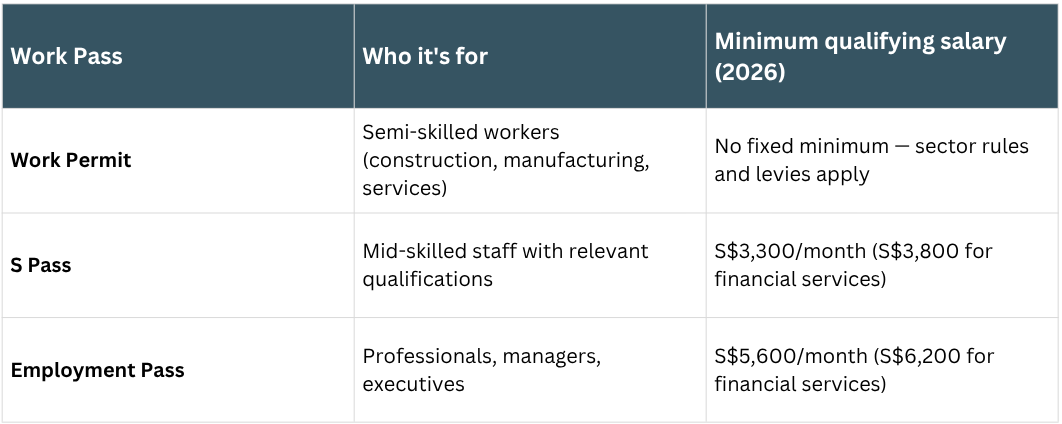
A couple of things have tightened recently: MOM has raised the Employment Pass salary bar and now scrutinises supporting documents more closely than before. The specifics shift often, so check MOM's current guidance before you apply.
A few things to know about the figures above. Those are MOM's floor salaries for younger applicants — the bar rises with age, so someone in their 40s needs to earn considerably more to qualify. Employment Pass applications also go through COMPASS, MOM's points-based check that weighs your salary, qualifications, and your employer's local hiring, so clearing the salary line alone isn't enough. And it's your employer who submits the application, not you — the role usually has to be advertised on MyCareersFuture first.
Progression is real, too. Work Permit to S Pass, S Pass to Employment Pass — each step comes with a higher salary and qualification bar, and a stronger pass also puts you on better footing for a PR application later.
For a detailed breakdown, see our guide on the differences between work passes.
Bringing family over, or studying here
Family and student routes are their own topic, so here's the short version. If you're bringing family over, the pass depends on who's sponsoring: Employment Pass and S Pass holders can sponsor a spouse and children on a Dependant Pass, while Singapore citizens and PRs can sponsor a wider circle — spouse, children, and parents — on a Long-Term Visit Pass. Students apply for a Student Pass through ICA's SOLAR+ system once an approved school has accepted them.
For the full picture — eligibility, LTVP+, documents, and how these routes can lead toward PR — see our guide to family, student, and long-term passes in Singapore.
Practical tips that actually move the needle
- Keep 6–12 months of payslips and your CPF statements consistent. Mismatches between the two are a common trip-up.
- Get non-English documents translated and certified before you submit, not after ICA asks.
- Don't spam the portal with status checks. PR takes months, work passes are usually quicker, and chasing doesn't speed anything up.
- If your case is complicated — a past rejection, an unusual family setup, a job change mid-application — that's the point where a second opinion earns its keep.
There's no scoring trick and no shortcut here. ICA assesses each case holistically, so the aim is simply a complete, honest, well-evidenced application.
What do I do after getting Singapore PR?
Once you've been approved, you should look to complete your formalities: PRs register for an NRIC, while work pass holders receive a FIN. From there, set up Singpass for government e-services, update your address with ICA, and open a local bank account. PRs can access subsidised healthcare and apply for HDB housing; work pass holders usually go private. With school-age kids, get onto the Ministry of Education timelines early.
After that, keep your status in good standing — PRs watch re-entry permit renewals, and everyone updates ICA or MOM whenever a job or personal detail changes.
How a Singapore Immigration Consultancy Can Help
Kenneth & Co is a Singapore immigration consultancy, and the right guidance can genuinely lift your PR chances. We assess your profile, flag the strengths and gaps, and guide you through PR, work pass, and family pass applications — which is where most avoidable errors and missed details get caught. That's especially valuable on complex or borderline cases.
We can't promise an outcome — no one honestly can — but we can make sure your application is as strong and complete as it should be.
Ready to kickstart your application? Book a free eligibility assessment and we'll tell you where you stand.


