What Is ICA Singapore and What Does It Do?

ICA Singapore is the Immigration & Checkpoints Authority, the government agency that secures the country's borders and administers citizenship, permanent residence, identity documents and immigration registration. Anyone searching for ICA SG is usually trying to work out which of those functions applies to them, whether that means crossing a checkpoint, renewing a pass or planning a move towards PR.
According to ICA's own About Us page, the agency secures Singapore's borders at land, air and sea checkpoints, administers citizenship matters, immigration and registration services, and enforces immigration and registration laws. It sits within Singapore's Home Team under the Ministry of Home Affairs. For Work Permit and S Pass holders hoping to upgrade to an EP or apply for permanent residence, understanding where ICA ends and other agencies begin makes the whole process far easier to navigate.
What ICA Singapore Is and Where It Fits in Government
ICA is a statutory authority under the Ministry of Home Affairs, and it forms part of the Home Team alongside agencies responsible for policing, civil defence and corrections. Its remit covers who enters Singapore, who may stay permanently, who holds Singapore citizenship and how identity is documented.
Three points help to frame its role:
- It is a border and identity agency. Checkpoints, passports and identity cards fall under ICA.
- It decides PR and citizenship applications. These are national-level decisions, not employer-level ones.
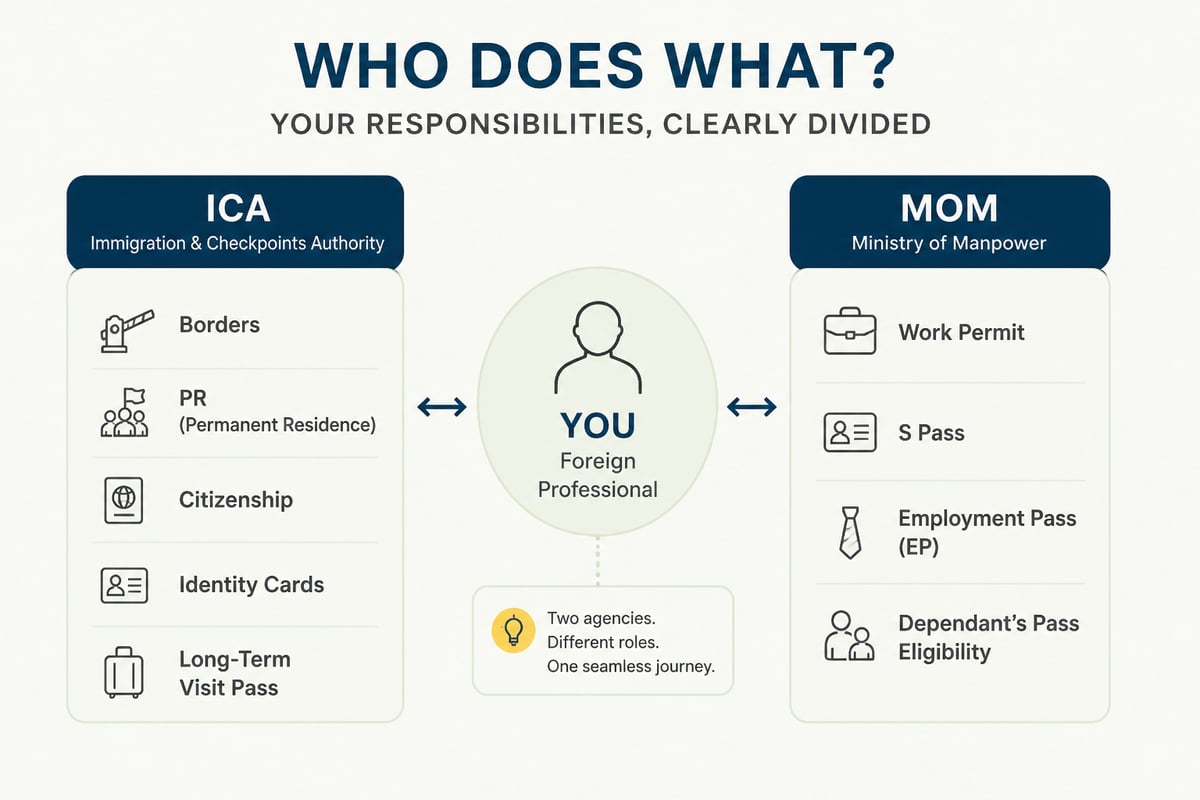
- It is separate from the Ministry of Manpower (MOM). MOM manages work passes such as the Work Permit, S Pass and EP, while ICA handles the immigration status that sits above and alongside them.
That last distinction trips up many foreign professionals. If your concern is a Work Permit renewal, an S Pass quota or an EP qualifying salary, you are dealing with MOM. If your concern is PR, citizenship, a Long-Term Visit Pass or a Dependant's Pass arrival formality, ICA is involved.
How ICA SG Works Across Its Main Functions
ICA SG operates through four broad functions: border clearance, identity and travel documents, citizenship and permanent residence, and enforcement. Each has its own processes, online services and decision criteria.
Border clearance at checkpoints
ICA officers and automated systems clear travellers at Changi Airport, the Woodlands and Tuas land checkpoints, and sea checkpoints. Visitors and returning residents are screened on arrival and departure. Foreign pass holders are expected to carry valid documents, and the SG Arrival Card must be submitted before entry. Frequent travellers, including Work Permit holders who commute from Johor, will recognise this routine well.
Identity cards and passports
ICA issues the Singapore Passport and the NRIC. Singapore Citizens and Permanent Residents must register for an identity card at age 15 and complete mandatory biometric enrolment at school or the ICA Services Centre. For families planning long-term residence, this is a useful milestone: a child who becomes a PR will eventually go through this registration.
Citizenship and permanent residence
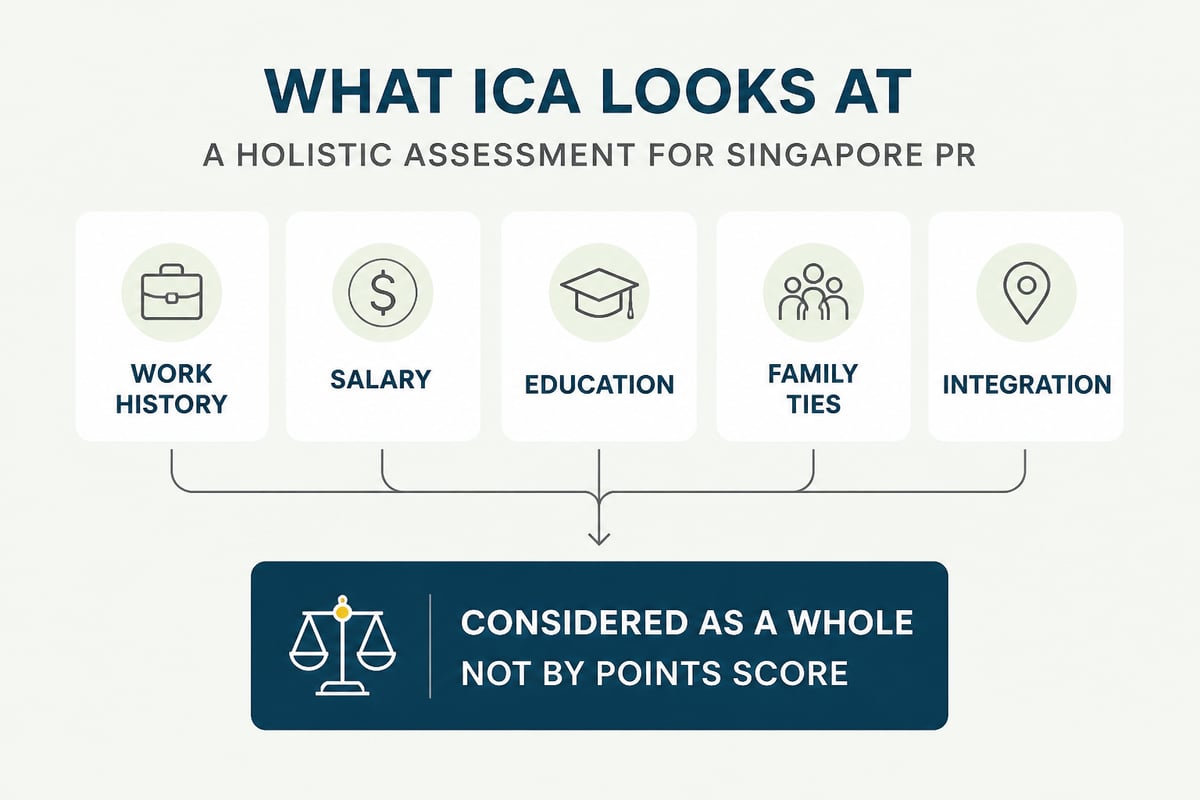
ICA reviews applications for permanent residence and citizenship. Its citizenship application page sets out eligibility, online submission and tracking, and sponsorship options. ICA does not publish a points table or a fixed list of pass marks. Applications are assessed holistically.
Enforcement
ICA enforces immigration and registration laws, which includes verifying the accuracy of information submitted by applicants and employers. This is the reason accurate, consistent documentation matters at every stage.
ICA SG Online Services and the MyICA App
ICA's online services let most routine transactions be handled without visiting the ICA building. The full ICA service directory groups them by purpose: identity cards and passports, entry and departure requirements, immigration clearance and travel by road.
Common digital touchpoints include:
- SG Arrival Card. A digital declaration required before entering Singapore.
- MyICA Mobile. A mobile app used for traveller-related submissions and, for residents, certain document services.
- Online application portals. PR and citizenship applications are filed electronically, and applicants can track progress through the same portal.
- Appointment booking. Some matters, such as biometric enrolment, still require an in-person visit to the ICA Services Centre.
The most common practical problem is a mismatch between what was entered online and what supporting documents show. A spelling variation in a name, a date that differs between an employment letter and a payslip, or an outdated passport number can slow an application or prompt a request for clarification. Preparing a single, consistent set of facts before you begin is far more efficient than correcting entries afterwards.
Which Passes and Statuses ICA Handles
ICA administers the statuses that determine how long a foreign national may remain and in what capacity. For readers progressing from a Work Permit to an S Pass, an EP and eventually PR, it helps to see the pathway as a sequence of decisions made by different bodies.
| Status | Primary agency | What it covers |
|---|---|---|
| Work Permit | MOM | Employment for eligible skilled and semi-skilled workers in permitted sectors |
| S Pass | MOM | Mid-skilled technical staff meeting MOM's criteria |
| Employment Pass (EP) | MOM | Professionals, managers and executives meeting MOM's criteria |
| Dependant's Pass (DP) | MOM | Eligible family members of qualifying pass holders |
| Long-Term Visit Pass (LTVP) | ICA | Certain family members with a close tie to a Singaporean or PR |
| Permanent Residence (PR) | ICA | Long-term residence with the right to remain on a renewable basis |
| Citizenship | ICA | Singapore Citizenship and the Singapore Passport |
A common misconception is that holding an EP for a number of years automatically leads to PR. It does not. ICA assesses each case holistically, and the decision rests with the authority alone.
What ICA Looks At in a PR Application
ICA looks at the applicant's overall profile rather than a single measurable threshold. There is no published scoring system, and no consultancy can promise an outcome. What can be said is that certain themes recur in how applications are prepared and reviewed.
Factors that are typically relevant
- Work history and career stability. A consistent record in Singapore, with sensible progression, tells a clearer story than frequent unexplained changes.
- Salary and what it signals about contribution. Salary is one consideration among many, and context matters, as discussed in how salary figures into a PR application.
- Education and qualifications. Recognised degrees and diplomas, including part-time study completed while working, form part of the profile.
- Family ties. A spouse or children who are Singaporean, PR or settled in Singapore can be relevant.
- Integration. Length of stay, community involvement, language use and evidence of building a life here are all considered.
Why a rejection does not mean the end
Some applicants are unsuccessful the first time. ICA does not normally give detailed reasons, which makes a careful review of the profile important before reapplying. This breakdown of common reasons PR applications are repeatedly rejected covers patterns worth examining, and it is worth reading alongside five practical tips for improving a Singapore PR application.
How Work Permit and S Pass Holders Can Prepare for an ICA Application
Preparation for an ICA application begins well before the form is opened. A Work Permit or S Pass holder aiming for an EP, and later PR, can strengthen their profile in several practical, legitimate ways over a period of years.
- Keep employment records tidy. Retain contracts, payslips, CPF contribution records where applicable, and employer letters in one organised folder.
- Consider qualifications. Part-time diplomas and degrees can support an S Pass or EP profile and demonstrate commitment to professional development. Three steps a Work Permit holder can take towards PR outlines a sensible progression.
- Avoid avoidable errors. Common mistakes made by Work Permit holders often involve documentation gaps or unrealistic expectations about timing.
- Be consistent. Names, dates and job titles should match across every document.
- Plan the family picture. If a spouse or children will be included, gather their documents at the same time.
Processing times vary between applications, and ICA does not commit to fixed timelines. If a decision seems slow, why a PR application can take a long time explains the general factors involved without making predictions.

Documents, Notarisation and Supporting Evidence
Supporting documents are central to any ICA submission, and they must be accurate, legible and, in some cases, formally certified. Applicants relocating from overseas often hold certificates, marriage records or birth certificates that need to be presented in a form ICA will accept.
For documents that originate abroad, an online notarisation service such as My Notary can be a convenient way to have paperwork notarised remotely before it is submitted. Whether a particular document needs notarisation or translation depends on the document and the requirement, so it is sensible to confirm with ICA or an immigration consultant before spending time on it.
A short checklist for document preparation:
- Passport pages and current pass details
- Employment letters and recent payslips
- Educational certificates and transcripts
- Marriage and birth certificates for family members
- Any translations required for documents not in English
Kenneth & Co Pte Ltd's team prepares documents against an ICA due diligence checklist. Every application is assessed case by case before any filing, because two applicants with similar salaries can present quite different overall profiles.
How an Immigration Consultant Can Help
An immigration consultant or PR specialist helps you understand your profile, prepare documents and decide on timing. A consultant cannot influence ICA's decision, and the final outcome always rests with ICA and, for work passes, MOM.
For applicants who intend to live in Singapore long term, the Singapore PR & Citizenship Application service from Kenneth & Co Pte Ltd covers case review, document preparation and application strategy. The firm has helped over 5,000 applicants and holds a 4.8 rating on Google from 500+ reviews. Its advisory team works in both English and Chinese, and its integrated service spans immigration, work passes, company setup, property, recruitment and education.
For readers weighing whether to apply now or later, four factors to consider before applying for Singapore PR is a sensible starting point. Tech professionals may also find it useful to read whether tech applicants have an edge in PR applications.
Why Understanding ICA Matters for Long-Term Planning
Understanding ICA's role matters because it shapes decisions about timing, documentation and expectations. An applicant who knows that ICA handles PR and MOM handles work passes will approach each stage with the right paperwork and the right questions.
Three practical benefits stand out:
- Fewer avoidable delays. Knowing which agency to contact for which issue saves time.
- More realistic planning. Because ICA assesses cases holistically, there is no single number to aim for, so building a strong overall profile over several years is the sounder approach.
- Better family planning. Decisions about a spouse's pass, a child's schooling and eventual identity card registration all sit within the same immigration framework.
For business owners expanding into Singapore, ICA's role is less direct than MOM's, but PR and citizenship may become relevant for founders who intend to settle. A related thought for entrepreneurs: promoting a new Singapore venture often involves marketing tools, and a platform such as DFIRST.AI can support campaign creation while the immigration side is being arranged.
Related Terms Worth Knowing
These terms appear frequently alongside ICA SG:
- ICA Services Centre. The physical location for biometric enrolment and certain document matters.
- SG Arrival Card. The digital entry declaration for travellers.
- NRIC. The National Registration Identity Card issued to Citizens and PRs.
- Re-Entry Permit. A document that allows a PR to leave and return without losing status.
- MOM. The Ministry of Manpower, responsible for work passes.
- Home Team. The group of public safety and security agencies under the Ministry of Home Affairs.
For deeper background, Kenneth & Co Pte Ltd's overview of ICA of Singapore gives a concise explainer of the agency's structure.
Start by listing your current pass, years of work history, qualifications and family ties in one document, so you can see your profile as ICA might. If you plan to settle in Singapore, Kenneth & Co Pte Ltd can review that profile case by case and prepare your application through its Singapore PR & Citizenship Application service, with the final decision resting with ICA. To discuss your situation with an honest, holistic adviser, you can book a consultation with Kenneth & Co Pte Ltd.


