S Pass Processing Time Guide: What to Expect in 2026
Singapore’s workforce is rapidly evolving, making S Passes increasingly vital for foreign professionals looking to contribute to key industries. As companies compete for skilled talent, the government has prioritised fair and efficient s pass processing time to support business needs and uphold local-foreign workforce balance.
Yet, many applicants and employers worry about s pass processing time, approval chances, and unexpected delays as 2026 approaches. What should you realistically expect, and how can you avoid setbacks?
This comprehensive guide will demystify s pass processing time in 2026. You will find a clear breakdown of eligibility, new trends, step-by-step timelines, common bottlenecks, and actionable strategies to maximise your approval speed.
Understanding the S Pass: Eligibility, Criteria, and 2026 Updates
Singapore’s S Pass scheme plays a pivotal role in shaping the city-state’s workforce. Designed for mid-skilled foreign workers, the S Pass allows employers to access essential talent for industries such as manufacturing, services, and marine. In contrast to the Employment Pass (EP), which targets higher-skilled professionals, and the Work Permit, which is for lower-skilled roles, the S Pass strikes a balance between skill and accessibility. For a detailed breakdown of these differences, you can refer to the Difference between Work Permit, EP, and S Pass guide. With government policies in 2026 emphasising a fair local-foreign workforce mix, understanding the S Pass framework is essential for anyone concerned about s pass processing time.

Overview of the S Pass Scheme
The S Pass was introduced to bridge the gap between highly skilled and entry-level workers. It is tailored for mid-skilled employees, such as technicians, supervisors, and service staff. Key industries benefitting from this scheme include precision engineering, healthcare, marine, and hospitality.
Below is a quick comparison of Singapore’s main work passes:
| Pass Type | Target Skill Level | Typical Industries | Quota/Dependency Ratio |
|---|---|---|---|
| Work Permit | Low-skilled | Construction, Marine | Yes |
| S Pass | Mid-skilled | Manufacturing, Services | Yes |
| Employment Pass | Highly-skilled | Finance, IT, Management | No |
In 2026, the S Pass remains a vital option for employers, given Singapore’s ongoing efforts to balance economic growth with local workforce priorities. For applicants, s pass processing time is a crucial consideration due to rising demand and competition.
Eligibility Requirements for 2026
To qualify for the S Pass in 2026, both applicants and employers must meet updated criteria:
- Minimum qualifying salary (expected to increase, reflecting market trends)
- Recognised academic qualifications or relevant professional certifications
- Employer’s adherence to quota and dependency ratio ceilings
- Demonstrated employer compliance with MOM regulations
- Enhanced digital verification of credentials
As these requirements grow stricter, applicants must pay close attention to every detail affecting their s pass processing time.
Recent and Upcoming Policy Changes Impacting S Pass
Between 2024 and 2025, Singapore introduced several policy adjustments to the S Pass, including higher salary thresholds and stricter enforcement of employer compliance. For 2026, more digitalisation is expected, with AI-powered document verification and transparent application tracking.
These changes aim to reduce errors and fraud, but may also impact s pass processing time. Applicants should stay informed about upcoming rules and system upgrades, as these can affect both documentation and approval rates.
Why Processing Times Matter in 2026
Rising demand for S Passes means longer queues and more scrutiny. For employers, delays in s pass processing time can disrupt hiring schedules, disrupt project launches, or even lead to lost business opportunities. For applicants, waiting too long can result in expired job offers or compliance risks.
Recent years have shown that even a week’s delay can have significant consequences, making it vital to understand the timeline and prepare accordingly.
Key Statistics and Trends
In 2024, the average S Pass approval rate was around 50 to 60 percent, with a median s pass processing time of three to seven weeks. Projections for 2026 suggest higher application volumes, driven by both economic recovery and policy tightening.
Feedback from employers and applicants highlights a growing emphasis on complete documentation and proactive follow-up. Many note that early preparation and understanding of the process are key to navigating s pass processing time successfully.
S Pass Application Process: Step-by-Step Timeline for 2026
Navigating the S Pass application process in 2026 can feel overwhelming, especially with evolving digital systems and stricter requirements. Understanding each stage is crucial for managing your s pass processing time and improving your chances of a smooth, timely result. Below, we break down each step, highlight typical timelines, and share practical tips to help you avoid common pitfalls.
Step 1: Pre-Application Preparation
The first step in reducing your s pass processing time starts with careful preparation. Collect all necessary documents, such as a valid passport, certified educational certificates, and a signed employment contract.
Employers must check their quota to ensure they have S Pass slots available before submission. Digital verification, including credential checks and using MOM’s self-assessment tools, is essential in 2026.
Common errors at this stage include missing pages in documents or mismatched details between forms and certificates. Double-check every entry to avoid unnecessary delays. Creating a checklist can help you stay organised and ready for the next step.
Step 2: S Pass Online Application Submission
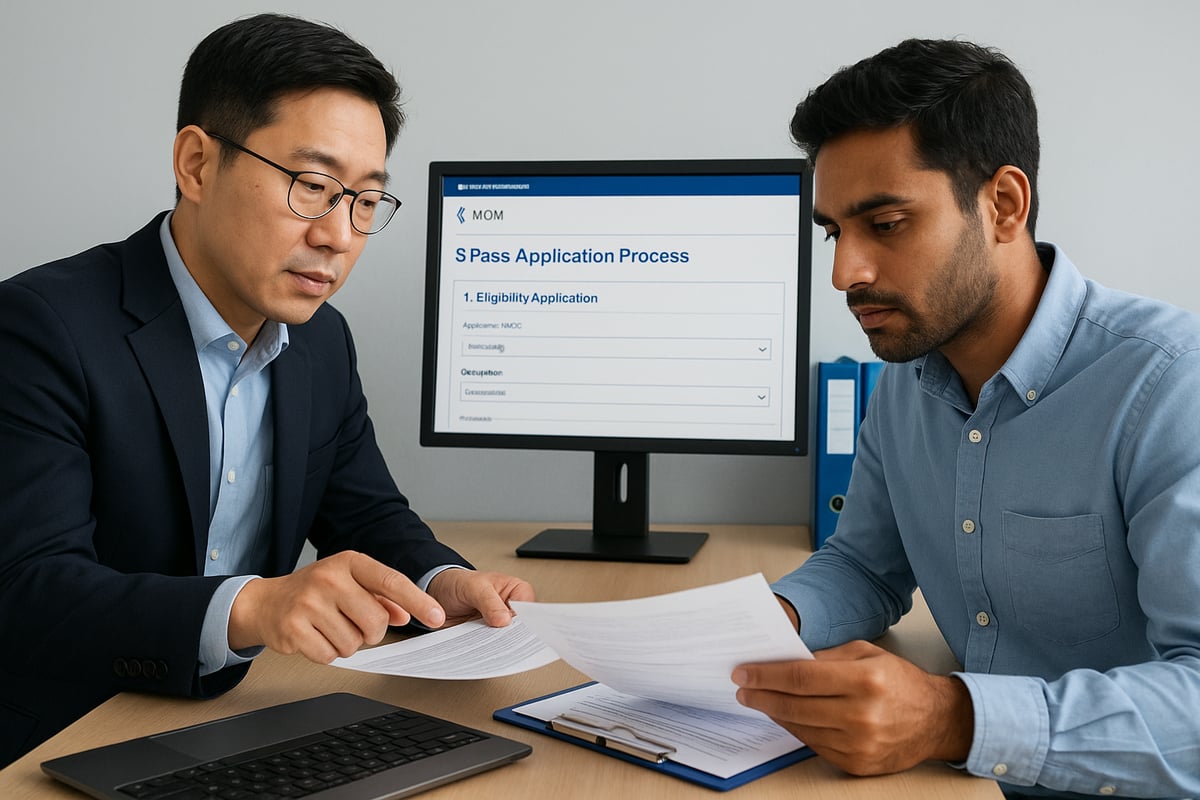
The employer is responsible for submitting the S Pass application through the Ministry of Manpower’s (MOM) online portal. This digital process now requires uploading all key documents and entering accurate applicant data.
Application fees are paid online, with receipts generated instantly. In 2026, upgraded security features protect sensitive information, and new interface updates streamline the process. For a detailed stepwise overview, refer to the S Pass Process Map, which visually outlines each application phase and relevant timelines.
To optimise your s pass processing time, ensure all supporting documents are clear, legible, and properly labelled before uploading.
Step 3: Initial Screening and Automated Checks
Once submitted, the application undergoes automated screening by MOM systems. AI-driven tools verify eligibility, scan documents, and detect inconsistencies or potential fraud. This automated check usually takes 1 to 3 working days, helping to speed up the s pass processing time for straightforward cases.
Immediate rejections may result from incomplete documentation or non-compliance with salary thresholds. Applications with minor discrepancies are flagged for manual review. Examples include mismatched names or unverified education credentials.
Applicants and employers should monitor their email and MOM portal for prompt status updates.
Step 4: Manual Assessment and Additional Queries
If the application is flagged, a MOM officer conducts a detailed review. This step can add 1 to 2 weeks to your s pass processing time, especially if the case is complex or supporting documents require further validation.
Officers may request additional documents, such as detailed employment contracts or further proof of qualifications. Common queries include questions about job scope or education authenticity. Responding quickly and clearly helps prevent further delays.
Keep all original documents accessible, and work closely with your employer’s HR team to address MOM’s requests efficiently.
Step 5: Approval, Rejection, and Issuance
After review, MOM will notify the employer and applicant of the outcome. Successful applicants receive an In-Principle Approval (IPA) letter, which is valid for a limited period. If rejected, applicants may appeal by providing additional information or clarifications, though this can extend the s pass processing time.
For approvals, the IPA outlines the next steps, including medical check-ups and formalities. Real-world cases show approvals can take anywhere from three weeks for straightforward applications to longer for complex profiles.
Always read the IPA letter carefully and act within the specified timeframe to maintain your application’s momentum.
Step 6: Post-Approval Formalities and Pass Collection
After IPA issuance, applicants must complete a medical examination at an approved clinic. Next, schedule an appointment with MOM for pass issuance.
During this visit, final document checks and biometric data collection (such as fingerprinting) are conducted. The s pass processing time for this stage is typically 1 to 2 weeks, depending on appointment availability and document readiness.
To avoid last-minute delays, ensure all required paperwork is in order and attend all scheduled appointments promptly. This final step confirms your eligibility and allows you to begin working legally in Singapore.
Factors Influencing S Pass Processing Time in 2026
Understanding the factors that shape s pass processing time in 2026 is essential for both employers and applicants. Each stage of the process can be affected by several key influences, ranging from application volume to unexpected global events.

Application Volume and Seasonal Trends
Fluctuations in application volume can significantly impact s pass processing time. During peak periods, such as after local university graduations or major industry hiring cycles, the Ministry of Manpower (MOM) typically receives a surge in applications.
This increased workload can result in longer wait times, even with improved digital systems. Conversely, off-peak months may see faster processing. Employers planning large recruitment drives should factor in these seasonal trends to avoid unnecessary delays.
- Peak periods: Post-graduation, Q1 and Q3 hiring waves
- Off-peak: Late Q2 and late Q4
- High volume can slow down s pass processing time
Proactive planning based on these patterns can help applicants and companies better manage expectations and timelines.
Employer Profile and Track Record
An employer’s compliance history is another important influence on s pass processing time. MOM evaluates each company’s past adherence to regulations, including quota management and record-keeping.
Employers with a strong compliance track record often experience smoother and quicker processing. However, those with previous infractions or quota breaches may face additional scrutiny, leading to longer assessments.
Key factors MOM reviews include:
- History of timely submissions
- No outstanding violations
- Adherence to dependency ratio ceilings
Employers should maintain transparent records and address any compliance issues proactively to minimise delays in s pass processing time.
Completeness and Accuracy of Documentation
One of the most common causes of extended s pass processing time is incomplete or inaccurate documentation. Missing educational certificates, incorrect personal details, or outdated forms can trigger requests for clarification or even rejection.
Applicants and HR teams should follow a detailed checklist and double-check every submission. For practical advice on avoiding documentation pitfalls, the Factors Affecting Your Work Permit Upgrade in 2024 article outlines common challenges and solutions relevant to work pass applications.
- Double-check qualifications and translations
- Ensure all supporting documents are current
- Use digital verification tools where possible
Taking these steps can help streamline the s pass processing time and reduce the risk of setbacks.
Policy and System Changes in 2026
Policy updates and technology rollouts can also influence s pass processing time. In 2026, new digitalisation initiatives, including AI-based screening and e-verification, are expected to enhance efficiency but may introduce initial learning curves.
For example, previous policy tightening or quota adjustments in 2024 and 2025 led to temporary slowdowns as stakeholders adapted. System upgrades can also cause brief interruptions, so staying informed about upcoming changes is crucial.
Table: Recent Policy Shifts and Impact
| Year | Policy/System Change | Impact on Processing Time |
|---|---|---|
| 2024 | Quota tightening | Slight delays |
| 2025 | Digital submission rollout | Short-term slowdowns |
| 2026 | AI-based screening | Expected long-term reduction |
Applicants should monitor MOM announcements to anticipate changes that may affect s pass processing time.
Applicant Profile and Background Checks
The individual applicant’s background can affect s pass processing time. MOM may apply extra scrutiny to certain nationalities, education backgrounds, or employment histories if they fall into higher-risk categories.
Background verification checks may include:
- Authenticity of academic qualifications
- Previous employment record checks
- Screening for security or compliance risks
If any concerns arise during these checks, applications may be referred for manual review, extending the timeline. Being transparent and providing verifiable information from the outset can help maintain a steady s pass processing time.
External Events and Contingencies
External events, such as economic changes, public health crises, or geopolitical shifts, can unpredictably impact s pass processing time. For instance, during the COVID-19 pandemic (2020–2022), processing times increased due to remote working and resource reallocation at MOM.
Other potential disruptions include:
- Economic downturns affecting hiring volumes
- MOM staffing changes or re-prioritisation
- Unexpected policy shifts in response to global events
Applicants and employers should have contingency plans and regularly check for updates. Staying adaptable ensures that any impact on s pass processing time is managed effectively.
How to Expedite Your S Pass Application: Tips and Best Practices
Speeding up your s pass processing time is crucial for both applicants and employers in 2026. By following proven strategies, you can avoid unnecessary setbacks and increase your chances of fast approval. Let us explore actionable steps to help you streamline every stage of the application.
Preparing a Complete and Error-Free Application
A well-prepared application is the foundation for minimising your s pass processing time. Begin with a thorough checklist:
- Valid passport with at least six months’ validity
- Accredited educational certificates, with certified translations if needed
- Signed employment contract stating all key terms
- Employer quota confirmation
- Any supporting credentials required by MOM
Before submission, cross-check all documents for accuracy and consistency. Common errors include mismatched dates, missing pages, or outdated forms. Use MOM’s self-assessment tools to pre-qualify before applying. Early preparation helps you respond quickly to any follow-up and keeps your s pass processing time on track.
Leveraging Employer Support and Track Record
Employers play a pivotal role in influencing s pass processing time. Companies with strong compliance records and efficient HR systems tend to experience fewer delays. HR teams should:
- Monitor quota usage and dependency ratios regularly
- Maintain organised digital records for easy retrieval
- Ensure all company information submitted matches MOM records
Open communication between HR and the applicant also helps resolve issues quickly. Employers with a history of timely, accurate submissions often see their s pass processing time shortened due to MOM’s trust in their processes.
Responding Promptly to MOM Requests
After submitting your application, it is vital to monitor its status on the MOM portal. MOM may request additional information or clarification if documents are incomplete or unclear. To keep your s pass processing time as short as possible:
- Check the application status daily
- Reply to MOM queries within 1-2 working days
- Provide clear, well-organised responses with supporting documents
Delays often occur when applicants or employers overlook MOM emails or submit vague answers. By responding promptly and concisely, you help MOM process your application faster and reduce s pass processing time risk.
Using Technology and Professional Assistance
In 2026, digital tools can make a significant difference in s pass processing time. Use secure cloud storage for document management and set up automated alerts for application status changes. Many applicants benefit from:
- Online checklists and form-filling assistance
- Secure file-sharing platforms for HR and applicants
- Status tracking apps for real-time updates
If your case is complex or you are unsure about eligibility, consider engaging a professional immigration consultant or legal advisor. Their expertise can help you avoid costly errors and streamline your s pass processing time.
How Professional Consultancy Can Help with S Pass Applications
Professional consultancy services specialise in navigating complex s pass processing time scenarios. Consultants offer tailored eligibility assessments, document reviews, and up-to-date advice on MOM requirements. For instance, How Professional Consultancy Can Help with S Pass Applications details proven frameworks that reduce delays and rejection risks.
With expert guidance, applicants benefit from personalised checklists, faster document preparation, and direct support in responding to MOM queries. Many successful 2026 applicants have expedited their s pass processing time by using these services, taking advantage of free profile evaluations and bespoke strategies for a smoother experience.
Common S Pass Processing Delays and How to Avoid Them
Delays in s pass processing time can disrupt hiring plans and create stress for applicants and employers alike. Understanding the most common causes and learning how to avoid them is crucial for a smooth application experience. In this section, we break down typical bottlenecks and offer practical strategies to keep your application on track.
Incomplete or Inaccurate Documentation
The most common reason for delays in s pass processing time is incomplete or inaccurate documentation. Errors such as missing pages, unverified certificates, or inconsistent details between forms and supporting documents can trigger requests for clarification or even outright rejection.
- Double-check all academic and professional certificates.
- Ensure translations are certified if documents are not in English.
- Verify that passport details match exactly across all forms.
Real-life cases have shown that even minor mistakes can lead to weeks of extra waiting. For a practical example of how documentation impacts timelines, see Zhi Yong's Journey: Work Permit to S Pass to PR. Taking time to review each document before submission can significantly reduce your risk of delay.
Employer Quota and Compliance Issues
S pass processing time can be affected if an employer exceeds their S Pass quota or fails to comply with dependency ratio ceilings. The Ministry of Manpower (MOM) strictly enforces these limits, and applications from non-compliant employers may be delayed or rejected.
- Check your company’s current quota status before applying.
- Maintain accurate records of your workforce mix.
- Address any previous compliance breaches proactively.
Employers with a history of quota issues may face extended review periods. Regular internal audits and open communication with HR can help prevent these bottlenecks.
Additional Verification and Background Checks
Certain factors, such as an applicant’s nationality, education background, or previous employment history, can trigger additional verification. This extra scrutiny often extends the s pass processing time, especially if documents require independent validation or if inconsistencies are found.
Applicants flagged for further checks can expect requests for:
- Additional proof of education or work experience.
- Official letters from previous employers.
- Clarification on gaps in employment history.
Being prepared with comprehensive, verifiable records can speed up this stage. Referencing real-world journeys, like those highlighted in published case studies, demonstrates how thorough preparation can avoid unnecessary delays.
System and Policy Changes
System upgrades or new government policy rollouts can disrupt the usual s pass processing time. For example, the introduction of digital verification tools or shifts in eligibility criteria may require additional review steps, causing temporary slowdowns.
- Stay informed about upcoming changes through official channels.
- Adjust application strategies to accommodate new requirements.
Recent years have seen digital submission systems and stricter documentation checks. For details on how new rules may impact future applications, consult the Upcoming changes to S Pass eligibility page. Adapting quickly to policy updates can help you stay ahead of potential slowdowns.
Applicant-Driven Delays
Sometimes, the cause of a slow s pass processing time lies with the applicant. Missed appointments for medical exams, late responses to MOM queries, or incomplete follow-up actions can all lead to avoidable setbacks.
To keep your application moving:
- Monitor your application status daily.
- Respond to all requests from MOM promptly.
- Schedule required appointments as soon as you receive approval.
Being proactive and organised is essential. Timely communication and preparation not only reduce anxiety but also ensure you do not miss critical deadlines.
S Pass Processing Time Trends and Projections for 2026
Understanding how the s pass processing time has changed over the years is key for both employers and applicants in 2026. By looking at historical data, projected timelines, and the latest policy changes, you can better anticipate what to expect and plan your hiring or job search strategy accordingly.
Historical Processing Time Data (2020–2025)
Trends in s pass processing time from 2020 to 2025 reveal how evolving policies and global events have shaped application outcomes. The Ministry of Manpower (MOM) reported significant variations during this period, especially in response to the pandemic and digitalisation drives.
Below is a summary table of average and median processing times:
| Year | Average Time (weeks) | Median Time (weeks) |
|---|---|---|
| 2020 | 5.5 | 5 |
| 2021 | 7 | 6 |
| 2022 | 6 | 5 |
| 2023 | 4.5 | 4 |
| 2024 | 3.5 | 3 |
| 2025 | 3–4 | 3 |
Key factors influencing these figures include system upgrades, surges in applications, and strict enforcement of new documentation standards. The s pass processing time has generally improved with increased automation, but spikes occurred during periods of policy adjustment.
Projected Processing Times for 2026
Looking ahead, the s pass processing time in 2026 is expected to remain within the 3 to 7 week range for most straightforward cases. The Ministry of Manpower has signalled that continued digitalisation should keep timelines stable, barring any major external shocks.
However, more complex applications, such as those with non-standard qualifications or flagged backgrounds, may see processing times stretch beyond 7 weeks. According to industry experts and sources like Singapore's New Work Visa Rules: What The Salary Changes Mean for You, salary threshold changes and stricter documentation checks could introduce minor delays, especially in the early months of policy rollouts.
Applicants and employers should factor in these projections when planning recruitment cycles or career moves, as even a week’s delay can impact business operations or job acceptance timelines.
Policy and Technology Drivers
The s pass processing time in 2026 will be shaped by a combination of policy tightening and advanced technology adoption. MOM is set to further leverage AI-driven screening and e-verification tools, aiming to reduce manual review and human error.
Recent years have seen policies shift towards greater transparency and stricter eligibility checks. The Singapore tightens S Pass rules report highlights how new requirements, such as digital credential verification and enhanced employer scrutiny, have streamlined some processes but also raised the bar for documentation quality.
These measures are expected to keep the s pass processing time efficient for well-prepared applications, while also deterring incomplete or non-compliant submissions.
Industry and Employer Perspectives
Employers across key industries such as manufacturing, services, and marine have observed that the s pass processing time is a critical factor in workforce planning. Many HR professionals report that the shift to digital systems has introduced both speed and predictability, helping them align recruitment with operational needs.
Industries with higher volumes of foreign hires often experience seasonal peaks, which can result in temporary processing slowdowns. Companies are increasingly building buffer periods into their hiring schedules, based on recent trends and the need to accommodate possible unforeseen delays in the s pass processing time.
Case studies show that proactive communication with MOM and rigorous internal compliance checks have helped some employers achieve faster outcomes and minimise disruptions during high-demand periods.
Applicant Experiences and Survey Data
Recent surveys of s pass applicants from 2024 and 2025 reveal a mix of satisfaction and frustration with the current system. The majority of successful applicants cite thorough document preparation and prompt responses to MOM queries as key to reducing their s pass processing time.
Common pain points include additional verification requests for overseas qualifications and delays during system upgrades. However, many applicants found that leveraging employer support and using digital application tools improved their overall experience.
Applicants planning for 2026 are advised to study recent trends, prepare for policy changes, and maintain open communication with employers to maximise their chances of timely approval.
After exploring the key factors that influence S Pass processing times and the practical steps you can take to streamline your application in 2026, you might still have questions about your unique situation or wonder how recent policy changes could affect your chances. That’s where personalised guidance can make all the difference. If you want to maximise your approval odds and avoid common delays, consider speaking with an expert who understands the ins and outs of Singapore’s evolving work pass landscape. You’re welcome to Book an appointment with Kenneth & Co. for tailored advice and support on your S Pass journey.


